Suma qamaña = convivir bien. ¿Cómo medirlo?

[Xavier Albó1] En la Constitución Política del Estado, vigente en Bolivia desde 2009, se reitera el concepto de “vivir bien” ya en su Preámbulo y en su Título I al señalar los grandes “principios ético-morales de la sociedad plural” (art. 8). Lo encontramos de nuevo también en otros temas como el educativo (art. 80) y el económico (art. 306, 313). ¿Qué está detrás de tal … Continue reading Suma qamaña = convivir bien. ¿Cómo medirlo?

It’s the time of the Rights of Mother Earth

[Pablo Solón, April 2011] (1) Victor Hugo, the author of Les Misérables, once wrote: “How sad to think that nature speaks and mankind doesn’t listen.” Although we often forget it, human beings are a force in nature. In reality, we are all a product of the same Big Bang that created the universe, although some only see wood for the fire when they walk through the forest. … Continue reading It’s the time of the Rights of Mother Earth

La renovación de la crítica al desarrollo y el buen vivir como alternativa

[Eduardo Gudynas y Alberto Acosta]  Introducción Las perspectivas recientes sobre educación ambiental y educación para la sostenibilidad de muy variadas maneras se enfocan en el “desarrollo sustentable”. Buena parte de la discusión queda centrada, por lo tanto, en cuestiones como determinar las condiciones ecológicas para el desarrollo, generar un desarrollo “verde” o alentar una sensibilidad ambiental. De alguna manera puede entenderse que esas posturas son … Continue reading La renovación de la crítica al desarrollo y el buen vivir como alternativa

From “Common Goods” to “The Common Good of Humanity”

[François Houtart, November 2011]  “…a complete theoretical rethinking is necessary, on the one hand dealing with all the elements that have led the world into a systemic crisis situa- tion and with the wearing out of a historical model; and on the other hand, redefining the objectives of a new social construct that is respectful of nature and capable of ensuring human life as a … Continue reading From “Common Goods” to “The Common Good of Humanity”

Armonía con la Madre Tierra

[Pablo Solon] Uno de los mayores descubrimientos de la civilización fue darse cuenta que la tierra no es plana y que vivimos sobre una esfera. Hoy estamos en medio de un descubrimiento mucho mayor en relación a la naturaleza de nuestro hogar.  A saber que la Tierra no es solamente redonda sino que es un TODO.El Proyecto de Resolución que el Estado Plurinacional de Bolivia … Continue reading Armonía con la Madre Tierra

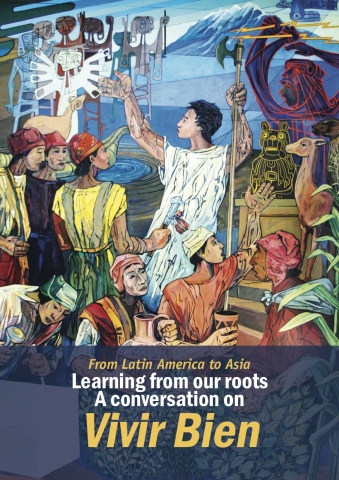
From Latin America to Asia Learning from our roots A conversation on Vivir Bien

[Focus on the Global South, 2013] What is Vivir Bien? Vivir Bien is a Spanish word that refers to the way of life of indigenous peoples in South America. The Aymara people call it sumaqamaña, the Quechua, sumakkawsay, the Peruvian Amazon, Kametsa Asaiki and the Guaraní, ñandereko. It can also be translated as “living well,” “good life,” “knowing how to live,” “inclusive life,” “sweet life,” … Continue reading From Latin America to Asia Learning from our roots A conversation on Vivir Bien

The Paradigm: Deglobalisation

[Focus on the Global South, 2003] It is in response to the growing clamor for alternatives to the current system of global governance that Focus has elaborated the strategy of deglobalisation as the guiding paradigm for its programmatic work in the next three-year period. Deglobalisation is not a synonym for withdrawing from the world economy.  It means a process of restructuring the world economic and political … Continue reading The Paradigm: Deglobalisation

“Deglobalization”? Sure, but…

[Patrick Bond, 2003] My favorite haunt, Zimbabwe, is the delight of aggressive bourgeois commentators, one of whom wrote a month ago about that country’s meltdown in the Economist (30 November 2002): “An interesting economic experiment is being conducted in Zimbabwe. To the foes of globalisation, President Robert Mugabe’s views are unexceptional. He argues that ‘runaway market forces’ are leading a ‘vicious, all-out assault on the … Continue reading “Deglobalization”? Sure, but…

Turning their backs on the world

[The Economist print edition, February 2009] The integration of the world economy is in retreat on almost every front. The economic meltdown has popularised a new term: deglobalisation. Some critics of capitalism seem happy about it—like Walden Bello, a Philippine economist, who can perhaps claim to have coined the word with his book, “Deglobalisation, Ideas for a New World Economy”. Britain’s prime minister, Gordon Brown, is among … Continue reading Turning their backs on the world

The Virtues of Deglobalization

[Walden Bello] The current global downturn, the worst since the Great Depression 70 years ago, pounded the last nail into the coffin of globalization. Already beleaguered by evidence that showed global poverty and inequality increasing, even as most poor countries experienced little or no economic growth, globalization has been terminally discredited in the last two years. As the much-heralded process of financial and trade interdependence … Continue reading The Virtues of Deglobalization

Stagnation with deflation: The crisis – Stage ten

[Oscar Ugarteche/Ariel Noyola Rodríguez, January 2014] Everything appears to indicate that stage ten of the crisis that began in August of 2007 has arrived in force; a crisis that has involved multiple bank failures and massive budgetary costs in the United States. This has been followed by serious adjustments in consumption that have resulted in an impact on the growth of the Eurozone economy as well as … Continue reading Stagnation with deflation: The crisis – Stage ten

The right of mother earth

[Leonardo Boff] Our future is in jeopardy. The interlinking of crises could create a tragedy. There is no political formulation of the interests of humanity or mother earth that protects their nature and cultures. For centuries we have lived under the jurisdiction of nation states and their assorted forms of sovereignty and autonomy.But as all problems become increasingly global, this political model is proving incapable … Continue reading The right of mother earth

La Madre Tierra como sujeto de dignidad y de derechos

[Leonardo Boff] El día 22 de abril de 2009 la Asamblea General de las Naciones Unidas en su 63ª sesión ha aprobado por unanimidad el proyecto presentado por el Presidente de Bolivia Evo Morales Ayma de que todo 22 de abril sea celebrado como el Día internacional de la Madre Tierra. Ya no se trata del Día de la Tierra, sino del Día de la Madre … Continue reading La Madre Tierra como sujeto de dignidad y de derechos

25 postulados para entender el “Vivir Bien”

[David Choquehuanca / entrevista] El canciller David Choquehuanca y uno de los estudiosos aymaras de ese modelo y experto en cosmovisión andina, conversó con LA RAZÓN durante una hora y media y explicó los detalles de estos principios reconocidos en el artículo 8 de la Constitución Política del Estado (CPE) “Queremos volver a Vivir Bien, lo que significa que ahora empezamos a valorar nuestra historia, nuestra … Continue reading 25 postulados para entender el “Vivir Bien”

La proyección de los Derechos de la Naturaleza

[Alberto Acosta] En los Derechos de la Naturaleza el centro está puesto en la Naturaleza. Esta vale por sí misma, independientemente de la utilidad o usos del ser humano, que forma parte de la Naturaleza. La compleja construcción de un proyecto de vida en común Toda Constitución sintetiza un momento histórico. En toda Constitución se cristalizan procesos sociales acumulados. Y en toda Constitución se plasma una … Continue reading La proyección de los Derechos de la Naturaleza

Una esperanza: La Era del Ecozoico

[Leonardo Boff] Vivimos bajo el mito del progreso, un control humano sobre el mundo no-humano para tener un PIB cada vez mayor. Quien haya leído mi artículo anterior El antropoceno: una nueva era geológica debe haberse quedado desolado. Y con razón, pues intencionadamente quise provocar tal sentimiento. En efecto, la visión del mundo imperante, mecanicista, utilitarista, antropocéntrica y sin respeto por la Madre Tierra y por los límites … Continue reading Una esperanza: La Era del Ecozoico

The Systemic Crisis & Reconfiguration of Capitalism

[Pablo Solón] We are living through a systemic crisis. It is not only a deep economic crisis; it is a crisis of humanity and of Planet Earth. It is a crisis that involves the entire society, the reconfiguration of imperialist and neo-colonialist powers, our values, the rights of women, the rights of nature and the rights of many groups that are oppressed and marginalized because of their nationality, culture, beliefs, sexual orientation and the existence of caste, patriarchal and authoritarian regimes.

Continue reading “The Systemic Crisis & Reconfiguration of Capitalism”

¿Es posible construir el socialismo del siglo XXI con el capitalismo del siglo XIX? El brócoli amargo

[Francois Houtart y María Rosa Yumbla] El cultivo de brócolis crece en Ecuador, como producto de exportación (el 97 %). En 2000, 3,359 hectáreas eran consagrados a la producción y en 2010, 5,000. Entre 2005 y 2013, el crecimiento de las exportaciones fue de 13 % anualmente. En 2012 se produjo 70.000 toneladas con un ingreso de 69 millones de dólares. En 2009, las exportaciones hacia los Estados Unidos representaban el 33.6 %, hacia el Japón, el 16.77 %, hacia Alemania, el 16.23 %, hacia los Países Bajos, el 14.57 % y hacia Suecia, el 7.05 %. En los últimos años el mercado se extendió a nuevos países, como Israel, haciendo reducir relativamente la parte de los EEUU. El Ecuador es el 6° exportador del producto en el mundo. En 2013, la producción destinada a los Estados Unidos era de 2000 toneladas mensuales con una entrada de 2 millones de dólares[1]. Existe un problema de competitividad. El costo de producción de Guatemala es de 2,215 dólares por hectárea, en México, 2,500, mientras en Ecuador es de 2,600. Por otra parte, la dolarización de la economía ecuatoriana no permite la adopción de políticas monetarias.

Elementos de la crítica antidesarrollista

[Miquel Amorós] El objetivo de esta disertación no es otro que el de exponer las líneas maestras por donde discurre la crítica real del capitalismo en sus últimas fases, a la cual hemos llamado antidesarrollista. En la segunda parte se analiza la propuesta del “decrecimiento”, es decir el tránsito “civilizado” hacia un nuevo sistema económico que no destruya al capitalismo sino que conviva con él.