
Chapter One of Amazing Artificial Intelligence*
Read the publication in full here
As stated in the introduction, Artificial Intelligence or AI for short is generally defined as the general ability of computers to emulate human thought and perform tasks in real-world environments – such as perceiving, analyzing, understanding and collating for synthesizing. Or as the Oxford dictionary defines it more technically, Artificial Intelligence is the theory and development of computer systems able to perform tasks that normally require human intelligence, such as visual perception, speech recognition, decision-making, and translation between languages. There is mention of Artificial General Intelligence by some AI proponents as their goal, but there is no official definition for that except that it is supposedly a goal of a higher kind of AI that is just as intelligent as a human. This is a faraway dream according to critics who say that not even these current AI tools available that show machine learning and deep learning are nowhere near the level of AI let alone AGI. Machine intelligence is still far off from reaching human intelligence, which is far more complex in ways that even e fully imagined.
AI tools, in reality, are present in many everyday things that one may not even think as having multiple algorithms hard at work. Here are some examples:
1. Speech recognition: If you have an iPhone, you most likely have asked Siri for help in directions or searching things on the internet, etc. This is a great example of a subset of AI, it converts human language into computer language and then back, allowing for this interaction.
(We won’t discuss Large Language Models here in this list because we will be delving deep into it in chapter three)
2. Biometrics: Those fingerprints you just gave the machine, usually seen at border immigrations, embassies or your own passport application centers, is powered by a subset of AI. The data is stored, analyzed and “learned” as it is trained to do by the algorithms given to it. This is effective on training on huge data, deep learning and then accessing the results when needed.
3. E-Commerce: AI tools are everywhere in e-commerce, in fact, this electronic commerce would not even have taken off if not for the development of several digital technologies, the exponential growth and spread of information and communications technologies; and most importantly the amassing of data in massive sets, or as it is called, Big Data, the most valuable resource of this operation. This is then used to train on, analyze, used in data analytics to produce various results needed and then using this analysis to learn the consumers likes and then targets advertising to them, enticing customers to purchase these items. This is called surveillance advertising using AI.
4. Automobiles: Many advancements have been made in the field of using various technologies, including AI tools and subsets to make driving safer, help the driver navigate with impressively accurate GPS (Global Positioning System) and employ emergency braking in cases where the driver cannot do so. That is just a short list of what advanced smart cars can do. Of course, the goal of many companies is to build self-driving vehicles and there are self-driving cars out there being tested, taking in feedback to further improve and to ensure with absolute certainty that these self-driving cars when released, are safe and will do no harm.
5. Human resource in hiring: Some corporations are using AI to do blind hiring; an AI programmer inputs the algorithms according to the specifications that the corporations want and from there, design it accordingly to each position that a person in real life will be applying to. This has been and continues to be highly controversial and has caused an uproar on all the possible harms such as all kinds of bias. The EU has even included in its proposed upcoming bill that an EU citizen can sue a company if they can show that an AI program harmed them, an example of which is this AI hiring process that has shown a whole range of bias against minorities and others.
(An algorithm, in case, a definition is needed, since it’s being essential to the process, is according to Cambridge, is a set of mathematical instructions or rules written by the encoder or computer engineer, AI designer, or a host of people who are responsible for writing the software that the automated systems or other technologies would then follow and implement)
There are also other examples such as in education, healthcare, agriculture, advertising, social media, but these are not simple examples to discuss. They are highly controversial and may have good and positive contributions, but these are also the areas where there are the most vulnerabilities, things done without consent, racism, bias, loss of privacy, the use of personal data, often without consent, against you or for profit or to manipulate you. This requires a whole other discussion as even the US and the EU amongst others, have identified some of these areas as target areas for their proposed policies and regulations given the harm these automated systems have done and continue to do.
The United States prefaces its Blueprint for an AI Bill of Rights with the acknowledgement of the harm that AI tech has brought about, “Algorithms used in hiring and credit decisions have been found to reflect and reproduce existing unwanted inequities or embed new harmful bias and discrimination. Unchecked social media data collection has been used to threaten people’s opportunities, undermine their privacy, or pervasively track their activity—often without their knowledge or consent.”[5]
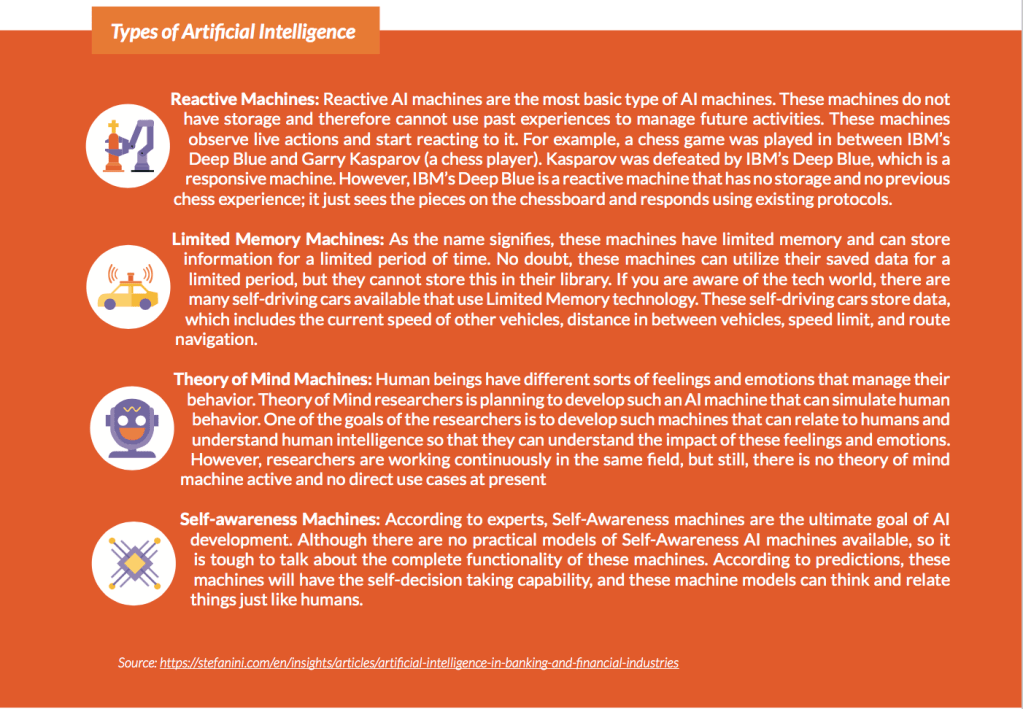
From these everyday examples, time now, for a small bit of a technical discussion just to understand the mechanics, or as a car mechanic would say, taking a look under the hood to see the engine and all that makes it work. First, there are four types of AI:
Then there are the subsets of AI which are machine learning and deep learning. There are different types or aspects of machine learning that include learning algorithms, training on data given to the machine, reinforcement learning where it learns more as it gets more feedback. “Machine learning and deep learning are both types of AI. In short, machine learning is AI that can automatically adapt with minimal human interference. Deep learning is a subset of machine learning that uses artificial neural networks to mimic the learning process of the human brain.”[6]

An early famous example of AI was the AlphaGo software developed by Google’s sister Deepmind. As the BBC had reported, after losing four times but beating the computer once at the game Chinese strategy game Go, the South Korean master Lee Se-Dol retired. “Lee Se-dol is considered to be one of the greatest Go players of the modern era. The 36-year-old former world champion started playing at the age of five, and turned pro just seven years later. His defeat by the AlphaGo software was seen as a landmark moment for artificial intelligence.” [7]
AI however has gone a long way since beating the Go Master. Its capabilities to data mine, do data analytics and turn that into profit in the digital economy has now made AI a very valuable technology but also one that has shown that it has gone from a benign Go player to a tool with the potential for good and for harm.
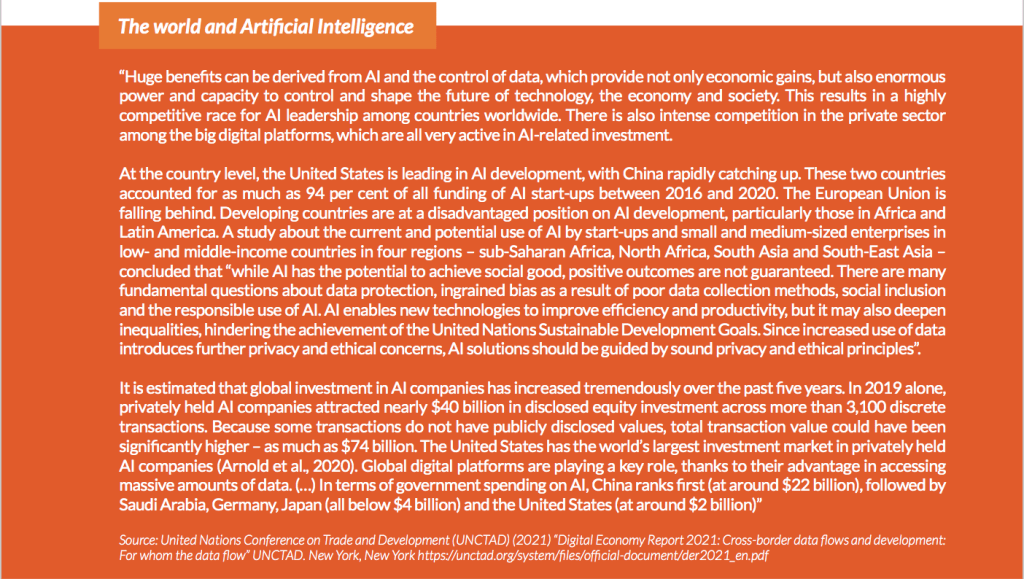
It has also become a global interest, the UNCTAD (United Nations Conference on Trade and Development) shows that countries have realized the significance and potential that comes with being the leader in this field of technology and as such have been investing resources.
The importance of understanding AI and its relationship with the digital economy is crucial because they are intertwined. So it is crucial to look at AI but from a perspective of the digital economy and the larger systemic view of the economy and building systemic alternatives and economic and social justice, is to understand just how much more exponentially can the digital economy expand and grow with a more advanced set of technology and tools using Artificial Intelligence and just as importantly, what impacts and consequences do these developments come with and whom do they benefit and whom do they harm?
The digital economy is a growing realm generally outside the spheres of the “traditional” neo-liberal economy, that is expanding in scope and reach. And although the economic activities are happening in a digital sphere, the general principles followed are still neo-liberal and with the exceptions of a sprinkling of smaller entities doing well and uplifting their communities, the majority of the digital economy is dominated by large transnational corporations focused on technology, or as they are called, the Big Tech companies.
Generally, there are three main pillars of the digital economy:
1. infrastructure that enables provision and access to the internet,
2. digital trade or e-commerce, and economic activities including commercial and professional business and services done online and
3. the expanse and access to information and communications technologies.
A significant tenet of this digital economy is that its main “natural resource” is data. So, if one were to say the traditional economy’s most valuable source of goods that they go to great lengths to extract are natural resources such as oil, minerals, and so much more; one could then say that the most valuable source for the digital economy is data. Data is information and although it is inherently with value, especially to the persons they belong or originate from, raw and unprocessed with other data, it is not yet as valuable as it has the potential to be. Just like a cocoa plant raw is more valuable when it is processed into the global value chain and comes out as a branded chocolate bar; so is raw data. Data is extracted (at times with no consent – this will be addressed later) then is processed as Big Data from which technologies such as AI can then use to analyze and produce analysis that is required by the platforms whether it be customers’ preferred products or music, tendencies towards certain choices, even political preferences.
[5] Blueprint for an AI BILL OF RIGHTS making automated systems work for the American People. White House Office of Science and Technology Policy. The White House October 2022 https://www.whitehouse.gov/ostp/ai-bill-of-rights/
[6] https://www.coursera.org/articles/ai-vs-deep-learning-vs-machine-learning-beginners-guide
[7] BBC Tech “Go master quits because AI ‘cannot be defeated” BBC News November 27, 2019 https://www.bbc.com/news/technology-50573071


One thought on “What is Artificial Intelligence”
Comments are closed.