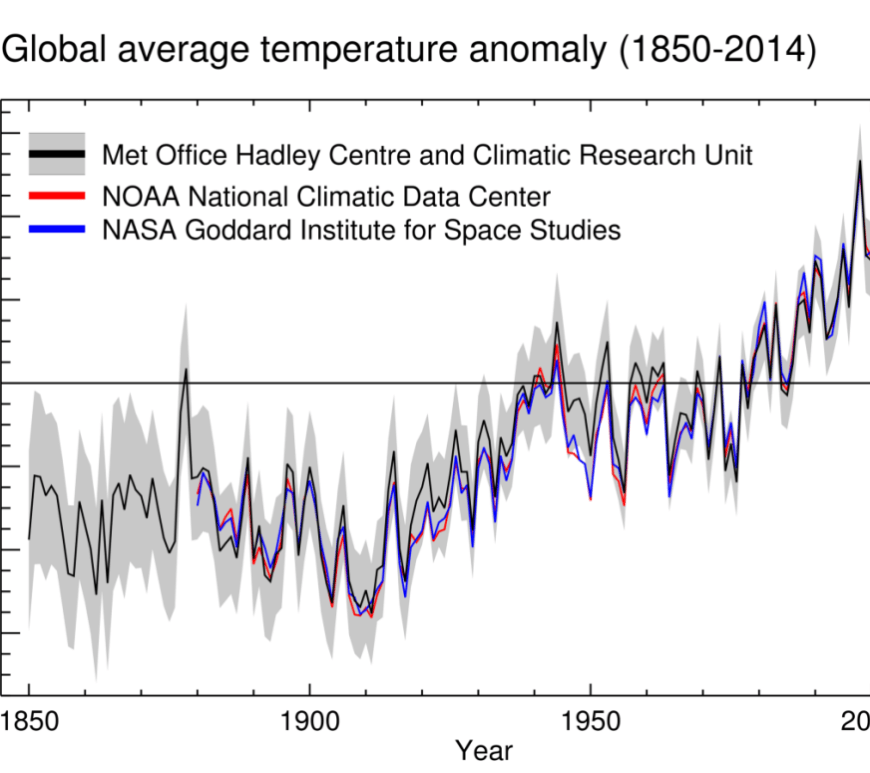
La tendencia al calentamiento prosigue en 2014

GINEBRA, 2 de febrero de 2015 – OMM: La Organización Meteorológica Mundial (OMM) ha clasificado 2014 como el año más caluroso del que se tenga registro, lo que se sitúa en una tendencia al calentamiento continua. Después de haber reunido los principales conjuntos de datos internacionales, la OMM observó que la diferencia de temperatura entre los años más cálidos era tan solo de varias centésimas … Continue reading La tendencia al calentamiento prosigue en 2014

The Commons as a Transformative Vision

[David Bollier and Silke Helfrich, in The Wealth of the Commons] It has become increasingly clear that we are poised between an old world that no longer works and a new one struggling to be born. Surrounded by an archaic order of centralized hierarchies on the one hand and predatory markets on the other, presided over by a state committed to planet-destroying economic growth, people … Continue reading The Commons as a Transformative Vision

Global Growth Revised Down, Despite Cheaper Oil, Faster U.S. Growth

WORLD ECONOMIC OUTLOOK UPDATE, IMF Survey, January 20, 2015 Global growth forecast at 3.5 percent for 2015, revised down by 0.3 percent Net benefit of plunge in oil prices more than offset by adverse factors Risks to global growth more balanced thanks to upside risks of lower oil prices Even with the sharp oil price decline—a net positive for global growth—the world economic outlook is still … Continue reading Global Growth Revised Down, Despite Cheaper Oil, Faster U.S. Growth

The climate is ripe for social change

[Vishwas Satgar] In a surprising departure from the corporate-controlled narrative on climate change, on November 30 2015, during the build-up to the recent United Nations COP20 climate summit in Lima, the New York Times ran a front-page story in which climate experts warned that “it now may be impossible to prevent the temperature of the planet’s atmosphere from rising by 3.6 degrees F”. “According to a … Continue reading The climate is ripe for social change

Sandinismo in Nicaragua: Non-State centered alternatives?

Alejandro Bendaña Today, many Sandinistas, not all of whom are in the FSLN governing party, ask ourselves ever actually achieved power—that is the power to effect revolutionary changes not only in terms of dismantling of the old, but the introduction of another model of economics, politics, and society. There was no guide or ideological foundation, and maybe that’s where the problem arises. Something called “Sandinismo” … Continue reading Sandinismo in Nicaragua: Non-State centered alternatives?

Green Governance: Ecological Survival, Human Rights and the Commons

[David Bollier & Burns H. Weston, wealthofthecommons.org] At least since Rachel Carson’s Silent Spring, we have known about humankind’s squandering of nonrenewable resources, its careless disregard of precious life species and its overall contamination and degradation of delicate ecosystems. In recent decades, these defilements have assumed a systemic dimension. Lately we have come to realize the shocking extent to which our atmospheric emission of carbon dioxide … Continue reading Green Governance: Ecological Survival, Human Rights and the Commons

What is Degrowth?

version française Geneviève Azam The public debate on growth was initiated in the late 1960s and early 1970s. One can mention, among others, the Meadows report for the Club of Rome in 1972[1], the United Nations Conference in Stockholm in 1972 and the stance taken by Sicco Manscholt (then vice-president of the European Commission) in the same year[2] and the publication in 1971 of Georgescu … Continue reading What is Degrowth?

Earth Democracy: Ten Principles of Justice, Sustainability and Peace

[Vandana Shiva] 1. Ecological Democracy – Democracy of all life We are all members of the Earth community. We all have the duty to protect the rights and welfare of all species and all people. No humans have the right to encroach on the ecological space of other species and other people, or treat them with cruelty and violence. 2. Intrinsic worth of all Species … Continue reading Earth Democracy: Ten Principles of Justice, Sustainability and Peace

Other Economies Are Possible: Building a Solidarity Economy

[Ethan Miller, 2009] Consider this: thousands of diverse, locally-rooted, grassroots economic projects are in the process of creating the basis for a viable democratic alternative to capitalism. It might seem unlikely that a motley array of initiatives such as worker, consumer, and housing cooperatives, community currencies, urban gardens, fair trade organizations, intentional communities, and neighborhood self-help associations could hold a candle to the pervasive and … Continue reading Other Economies Are Possible: Building a Solidarity Economy

Towards an Agrarian Revolution!

Synthesis of Discussions at the International Meeting: “Agrarian Reform and the Defense of Land and Territory in the 21st Century: The Challenge and Future,” held in Bukit Tinggi, West Sumatera, Indonesia, July 10th- 13th, 2012 Prepared by Shalmali Guttal with inputs from Sofia Monsalve, Rebeca Leonard and all participants at the International Meeting. An adapted version was published in the Journal of Peasant Studies 40:4 (2013), … Continue reading Towards an Agrarian Revolution!

Development from the Bottom Up

[Sulak Sivaraksa, from The Wisdom of Sustainability, 2009] There is an old Thai saying, “In the fields there is rice; in the water there are fish.” Before colonialism, the fertile lands of Southeast Asia – known as the Rice Bowl of Asia – provided food for all its people. Plants grew everywhere, wildlife was plentiful, jungles produced teak and other hardwoods, and the human population … Continue reading Development from the Bottom Up

Ecofeminism Revisited: Rejecting Essentialism and Re-Placing Species in a Material Feminist Environmentalism

[Greta Gaard] ©2011 Feminist Formations, Vol. 23 No. 2 (Summer) pp. 26–53. Formulated in the 1980s and gaining prominence in the early 1990s, by the end of that decade ecofeminism was critiqued as essentialist and effectively discarded. Fearing their scholarship would be contaminated by association with the term “eco-feminism,” feminists working on the intersections of feminism and environmentalism thought it better to rename their approach. … Continue reading Ecofeminism Revisited: Rejecting Essentialism and Re-Placing Species in a Material Feminist Environmentalism

Systemic Alternatives workshop August 21 2014

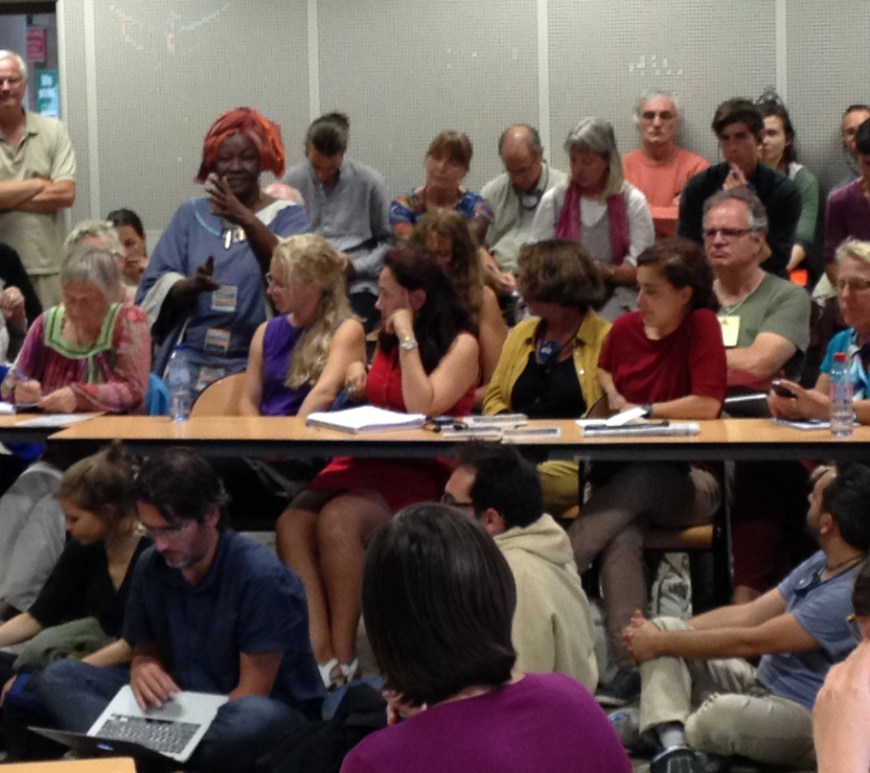
Systemic Alternatives workshop in the European Summer University of Social Movements of ATTAC, Paris, August 21 2014. More than one hundred participants in the dialog between Buen Vivir, deglobalization, the commons, degrowth, rights of Mother Earth… with Susan George, Alberto Acosta, Genevieve Azzam, Walden Bello, Christophe Aguiton, Aminata Traoré, Pablo Solón  and many others. Continue reading Systemic Alternatives workshop August 21 2014

The Role of Water Abuse in Climate Chaos

[Maude Barlow] Notes for the International Women’s Earth and Climate Summit. New York City, September 20-23, 2013 There is a crucial, missing component in the both the current analysis of climate chaos and in the proposed solutions to it. Most climate academics and activists see climate chaos as almost solely the result of greenhouse gas emissions from the burning of fossil fuels as well as methane … Continue reading The Role of Water Abuse in Climate Chaos

Notes for the debate: The Rights of Mother Earth

Versión en español Download this text in PDF format “Nature is a subject and not a collection of objects.” -Thomas Berry What are the rights of Mother Earth? A new vision of our relationship with nature, a new legal framework, a set of ethical principles, a strategy with which to question the superpowers of transnational corporations? The Rights of Mother Earth refers to all of … Continue reading Notes for the debate: The Rights of Mother Earth

SOUTH/SOUTH COLABORATION FOR A POST-CAPITALIST PARADIGM

[François Houtart[1]] In July 2014 a new step was taken towards constructing a multi-polar world, with the meeting in Brazil of the BRICS, the constitution of a new Bank and of a Fund for Development. This was followed by a joint meeting between the BRICS, UNASUR, the Organization of the South American States and CELAC (the Community of Latin America and the Caribbean). All this happened … Continue reading SOUTH/SOUTH COLABORATION FOR A POST-CAPITALIST PARADIGM

Notes for the Debate: Vivir Bien / Buen Vivir

We recommend to read the Chapter Vivir Bien in the book Systemic Alternatives  https://systemicalternatives.org/2017/03/14/vivir-bien-2/ Versión en español Let’s walk with our backs toward the future and our eyes on the past, so we can find our way to utopia. What is Vivir Bien? Is it an idea that reclaims ethical principles and knowledge? A practice or proposal of the Andean indigenous peoples? A philosophy? A paradigm … Continue reading Notes for the Debate: Vivir Bien / Buen Vivir

Deglobalization

[Nicola Bullard] The term ‘deglobalization’ spread in debates on globalization after Walden Bello, one of the leading figures of the anti-globalization movement, elaborated the idea in several articles published in 2001. Bello developed the programme most fully in his 2002 book, Deglobalization: Ideas for a New World Economy. There he affirmed that ‘deglobalization … is about re-orienting economies from the emphasis on production for export … Continue reading Deglobalization

The Deglobalisation Paradigm: A Critical Discourse on Alternatives

[Dorothy Grace Guerrero]  Introduction The continuing and intensifying global economic crisis that started in the Eurozone and the United States (US), and has reverberated in India, China and other developing countries, is a concrete manifestation of the depth reached by globalisation. The world has experienced a number of financial crises before. However, the combination of the economic and ecological crises, the impacts of drastic reforms … Continue reading The Deglobalisation Paradigm: A Critical Discourse on Alternatives

Video: Tim Jackson’s TED Talk: An economic reality check

[Tim Jackson, 2010] As the world faces recession, climate change, inequity and more, Tim Jackson delivers a piercing challenge to established economic principles, explaining how we might stop feeding the crises and start investing in our future. Of the credit and debt cycle, he says: “This is a strange, rather perverse story. It’s a story about us, people, being persuaded to spend money we don’t have on things … Continue reading Video: Tim Jackson’s TED Talk: An economic reality check