La justicia climática: entre la tutela y la fiscalización de las responsabilidades / Climate Justice: Between the Guardianship and the Fiscalization of Responsibilities

[SusanaBorras Pentinat*] La justicia climática: entre la tutela y la fiscalización de las responsabilidades Climate Justice: Between the Guardianship and the Fiscalization of Responsibilities Para acceder al PDF completo, haga click aquí: La justicia climática entre la tutela y la fiscalización de responsabilidades   Resumen El aumento del nivel de emisiones de gases de efectos invernadero intensifica el cambio climático y sus consecuencias, especialmente, en … Continue reading La justicia climática: entre la tutela y la fiscalización de las responsabilidades / Climate Justice: Between the Guardianship and the Fiscalization of Responsibilities

11th WTO Ministerial – Letter from Global Civil Society about the Agenda of the WTO

[Delivery date: 9 October, 2017] Below this whole letter, you are going to find links with pdfs about this letter, in French, Español, and Greek. Here you have the English version: 11th WTO Ministerial – Letter from Global Civil Society about the Agenda of the WTO Dear Members of the World Trade Organization (WTO), We are writing as 300[i] member organizations of global civil society … Continue reading 11th WTO Ministerial – Letter from Global Civil Society about the Agenda of the WTO

Has ‘Degrowth’ Outgrown its Own Name?

[Kate Raworth, http://commonstransition.org%5D The following article presents a debate that was first published on From Poverty to Power, a conversational blog maintained by Duncan Green. It is kicked off by Kate Raworth, renegade economist and development re-thinker, who feels that degrowth has outgrown its name. In reply Giorgos Kallis, the world’s leading academic on degrowth, counters with the view that ‘degrowth’ is still a compelling term. Let the debate begin… Why Degrowth has out-grown … Continue reading Has ‘Degrowth’ Outgrown its Own Name?

A Synopsis: Limits to Growth: The 30-Year Update

[Donella Meadows*, Jorgen Randers, and Dennis Meadows] The following piece is a short synopsis of Limits to Growth: The 30-Year Update. The full length book is available at Chelsea Green’s website. The whole book available here: Limits-to-Growth-digital-scan-version_Meadows, Donella A Synopsis: Limits to Growth: The 30-Year Update The signs are everywhere around us: Sea level has risen 10–20 cm since 1900. Most non-polar glaciers are retreating, … Continue reading A Synopsis: Limits to Growth: The 30-Year Update

Austerity and Degrowth – Dealing with the Economic Crisis and the Ecological Crisis Together

[ Brian Davey, originally published by Feasta]   This article arises from increasing frustration and irritation about the way that the debate about Greece, and in general about austerity, is framed. My frustration is not only with the policy thugs who are implementing austerity, but also, to a degree, with their critics – which includes the failure of most of the critics of growth to … Continue reading Austerity and Degrowth – Dealing with the Economic Crisis and the Ecological Crisis Together

‘Indigenous peoples are the best guardians of world’s biodiversity’

[David Hill, Wednesday 9 August 2017] Interview with UN Special Rapporteur Victoria Tauli-Corpuz to mark the International Day of the World’s Indigenous Peoples. UN Special Rapporteur Victoria Tauli-Corpuz, a Kankanaey Igorot woman from the Philippines. Photograph: Pierre Suu/Getty Images for UND. Today is the United Nations’ (UN) International Day of the World’s Indigenous Peoples, numbering an estimated 370 million in 90 countries and speaking roughly … Continue reading ‘Indigenous peoples are the best guardians of world’s biodiversity’

The Anthropocene Myth

[Andreas Malm*] Blaming all of humanity for climate change lets capitalism off the hook. Last year was the hottest year ever recorded. And yet, the latest figures show that in 2013 the source that provided the most new energy to the world economy wasn’t solar, wind power, or even natural gas or oil, but coal. The growth in global emissions — from 1 percent a year … Continue reading The Anthropocene Myth

State petroleum and climate change

[Gerardo Honty*, 02.08.17]   The biggest iceberg in history just broke off in Antarctica, while in the Arctic, the present temperatures are the highest ever registered. Heat waves are once again roasting the Northern Hemisphere, while in the South, the glaciers are losing mass. In spite of this, the world continues to invest enormous sums of money in the exploitation of petroleum, gas and coal, … Continue reading State petroleum and climate change

Prepare Now for the Next Financial Crisis

[Martin Khor*, PENANG, Malaysia, Jul 22 2017 (IPS)] The Asian financial crisis started 20 years ago and the global financial crisis and recession 9 years back. When a new global financial crisis strikes, the developing countries will be more damaged than in the last crisis as they have become less resilient and more vulnerable.  They thus need to prepare from being overwhelmed. A debate is … Continue reading Prepare Now for the Next Financial Crisis

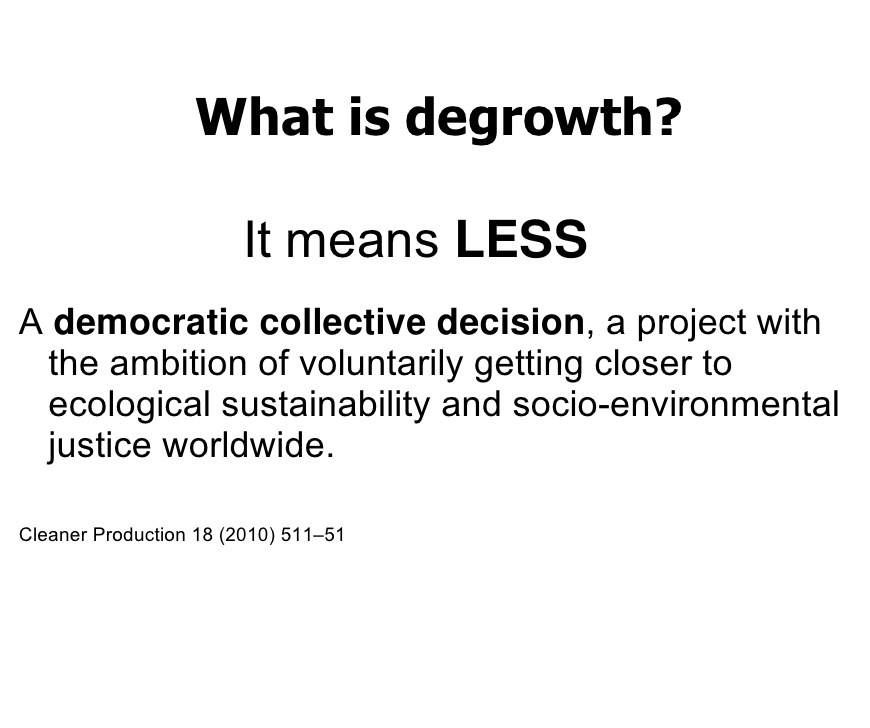
What is degrowth?

[www.degrowth.org] Sustainable degrowth is a downscaling of production and consumption that increases human well-being and enhances ecological conditions and equity on the planet. It calls for a future where societies live within their ecological means, with open, localized economies and resources more equally distributed through new forms of democratic institutions. Such societies will no longer have to “grow or die.” Material accumulation will no longer … Continue reading What is degrowth?

“Debemos pensar una izquierda posprogresista, antipatriarcal y profundamente ecológica”

[Leonardo Rossi para La tinta, Redacción La Tinta, 10 Julio, 2017 ] ‘Del cambio de época al fin de ciclo’ es el nuevo libro de Maristella Svampa, donde analiza los progresismos que gobernaron la región en los últimos años. “No hay nada que festejar con el fin del ciclo progresista”. Con esas palabras inició su exposición la socióloga Maristella Svampa. No obstante, remarcó: “No podemos dejar de … Continue reading “Debemos pensar una izquierda posprogresista, antipatriarcal y profundamente ecológica”

Nuevas decepciones de la globalización

[GERARDO DEL CERRO SANTAMARÍA, http://www.noticiasdegipuzkoa.com, 06.07.17] El renacimiento de sentimientos y políticas proteccionistas en las economías más avanzadas del globo de que estamos siendo testigos obedece en buena parte a la gran recesión de 2008, que originó a su vez un frenazo en el proceso de integración económica planetaria que llamamos globalización. Según la UNCTAD (United Nations Conference on Trade and Development-Conferencia de Naciones Unidas … Continue reading Nuevas decepciones de la globalización

We need rights of nature legislation now to protect our home planet

[Michelle Bender, http://www.theecologist.org ] We need a new paradigm for ocean governance focused on well-being and guided by principles of sustainability, ecosystem health, precaution and interconnectedness, argues MICHELLE BENDER of the US based Earth Law Centre. The first United Nations Ocean Conference brought together governments, stakeholders, businesses, and civil society representatives. The ocean covers over seventy percent of our planet, generates over fifty percent of … Continue reading We need rights of nature legislation now to protect our home planet

Degrowth: the case for a new economic paradigm

[Riccardo Mastini, Lund University, published on Open Democracy on 08.06.2017] Unbridled growth appears to be at odds with social well-being and environmental sustainability. How might we develop a model that reduces the imperative for growth while maintaining economic stability? Traffic in Dhaka: Pollution and congestion are two costly consequences of economic growth. joiseyshowaa/Flickr. Some rights reserved. In the 1970s, the emphasis was on resource limits. … Continue reading Degrowth: the case for a new economic paradigm

The Most Radical Aspect of Jeremy Corbyn’s Program? Democratizing the Economy

BY MICHAL ROZWORSKI. This story was first published at Jacobin.  So much about the 2017 Labour election campaign has been heartening: the energy, the conviction, the full-throated embrace of remaking government in the service of the many. All of the main campaign pledges — from free tuition to thousands of new homes to a stronger National Health Service — will change where money and resources flow … Continue reading The Most Radical Aspect of Jeremy Corbyn’s Program? Democratizing the Economy

Promoting the Commons in the Time of Monsters

Can the Commons and peer-to-peer (P2P) practices really offer viable solutions for our present and future social, political and ecological crises? Spain’s municipal successes remind us who the victor was in the battle between David and Goliath. The Commons is maturing politically, its methods and principles becoming more visible and its participants winning municipal elections in a variety of European cities. How did this happen, … Continue reading Promoting the Commons in the Time of Monsters

US pull-out from Paris deal: What it means

By Martin Khor By withdrawing the United States from the Paris Agreement, President Donald Trump abdicated not only leadership but membership of the community of nations cooperating to tackle climate change, the most serious crisis facing humanity. Trump’s announcement was shocking, even though it was not unexpected. It was shocking for showing the extreme lengths to which the President would go to deny scientific opinion … Continue reading US pull-out from Paris deal: What it means

Our food is not your business

Alternatives to unsustainable livestock and feedstock farming and the current corporate free trade model This briefing paper aims to contribute to the many ongoing efforts, actions, and discussions on alternatives to industrial livestock production, whether local, specific or systemic. It considers how we can strengthen, link and build on existing genuine alternatives, as well as creating new ones, together with social movements, small farmers, small … Continue reading Our food is not your business

Complementarities

By Pablo Solón Complementarity means to complete each other; it is to seek a whole that is diverse; it is a dialogue among those who are different; is to learn from the other and contribute to another; it is to recognize your own strengths and weaknesses in order to transform yourself in the interactions with others. Complementarity is to combine forces to optimize the potential … Continue reading Complementarities

Deglobalisation

By Pablo Solón Deglobalisation does not promote isolation or autarchy, but rather a different kind of global integration that is not dominated by capital. Deglobalisation is about thinking and building alternative integration models with people and nature at the centre. Globalisation is not a process in which growing interdepen-dence and integration have been made possible thanks to advances in communications and the internet. In this … Continue reading Deglobalisation